RBAC with Pattern
Quick start
-
Without domains — Register a matching function for
g:e, _ := NewEnforcer("./example.conf", "./example.csv")
e.AddNamedMatchingFunc("g", "KeyMatch2", util.KeyMatch2) -
With domains — Use the domain-aware API:
e.AddNamedDomainMatchingFunc("g", "KeyMatch2", util.KeyMatch2) -
Both — Call both APIs if your model uses patterns in both user–role and domain matching.
You must call these after creating the enforcer; they define how pattern matching is evaluated.
If using the online editor, add a pattern matching function by clicking the "Add Role Matching" button in the lower left corner.
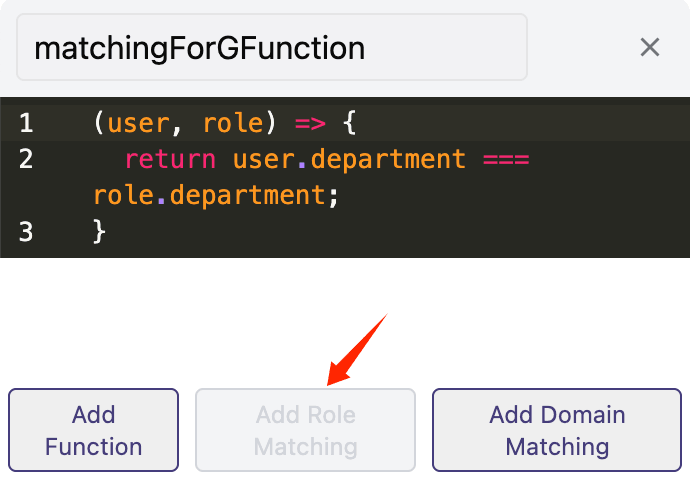
How pattern matching works
Pattern matching lets a single policy line match many subjects, objects, or domains (e.g. /book/:id matching /book/1, /book/2). The functions use the same signature as matcher functions; you register them for the parameters of g.
Example: without pattern matching you might write:
p, alice, book_group, read
g, /book/1, book_group
g, /book/2, book_group
So alice can read every book, but you need one g line per book. For many books, use a pattern instead:
g, /book/:id, book_group
Casbin then matches /book/1, /book/2, etc. to /book/:id. Register the matching function:


e.AddNamedMatchingFunc("g", "KeyMatch2", util.KeyMatch2)
await e.addNamedMatchingFunc('g', Util.keyMatch2Func);
For domain pattern matching (e.g. g(r.sub, p.sub, r.dom)), use:
e.AddNamedDomainMatchingFunc("g", "KeyMatch2", util.KeyMatch2)
await e.addNamedDomainMatchingFunc('g', Util.keyMatch2Func);
For the meaning of g(r.sub, p.sub, r.dom) see RBAC with domains. Full example: model_test.go.
Pattern matching with domains supports custom domain token names. Instead of dom, you can use any identifier like tenant or workspace. Casbin automatically detects the domain token name from your model definition when using pattern matching functions like keyMatch.
Domain wildcards: you can use a wildcard in the domain position of g to grant a role in all domains. Example:
p, admin, domain1, data1, read
p, admin, domain1, data1, write
p, admin, domain2, data2, read
p, admin, domain2, data2, write

g, alice, admin, *
g, bob, admin, domain2
So alice has the admin role in every domain (*), while bob is admin only in domain2. Pattern matching and domain wildcards keep policies short when you have many domains or resources.