Authorization in APISIX Using Casbin

Вступ
APISIX is a high-performance, scalable, cloud-native API gateway built on Nginx and etcd, and an Apache Software Foundation project. It ships with many plugins for authentication, monitoring, routing, and more. Plugins are hot-reloaded without restarts, so you can change behavior on the fly.
When you need authorization beyond simple checks, the authz-casbin plugin can help. It is an APISIX plugin built on Lua Casbin that enforces flexible authorization using models such as ACL, RBAC, and ABAC. Casbin is an authorization library (originally in Go, now ported to many languages); Lua Casbin is the Lua port. We proposed the plugin in the APISIX repo (#4674); after review and improvements, it was merged (#4710).
This post shows how to implement Role-Based Access Control (RBAC) in APISIX using authz-casbin.
Note: Casbin handles authorization only. Use another plugin or your own logic for authentication (identifying the user).
Створення моделі
The plugin authorizes each request using three parameters: subject, object, and action. The subject comes from a header (e.g. username: alice), the object is the URL path, and the action is the HTTP method.
Suppose we have three paths: /, /res1, and /res2. We want a model like this:
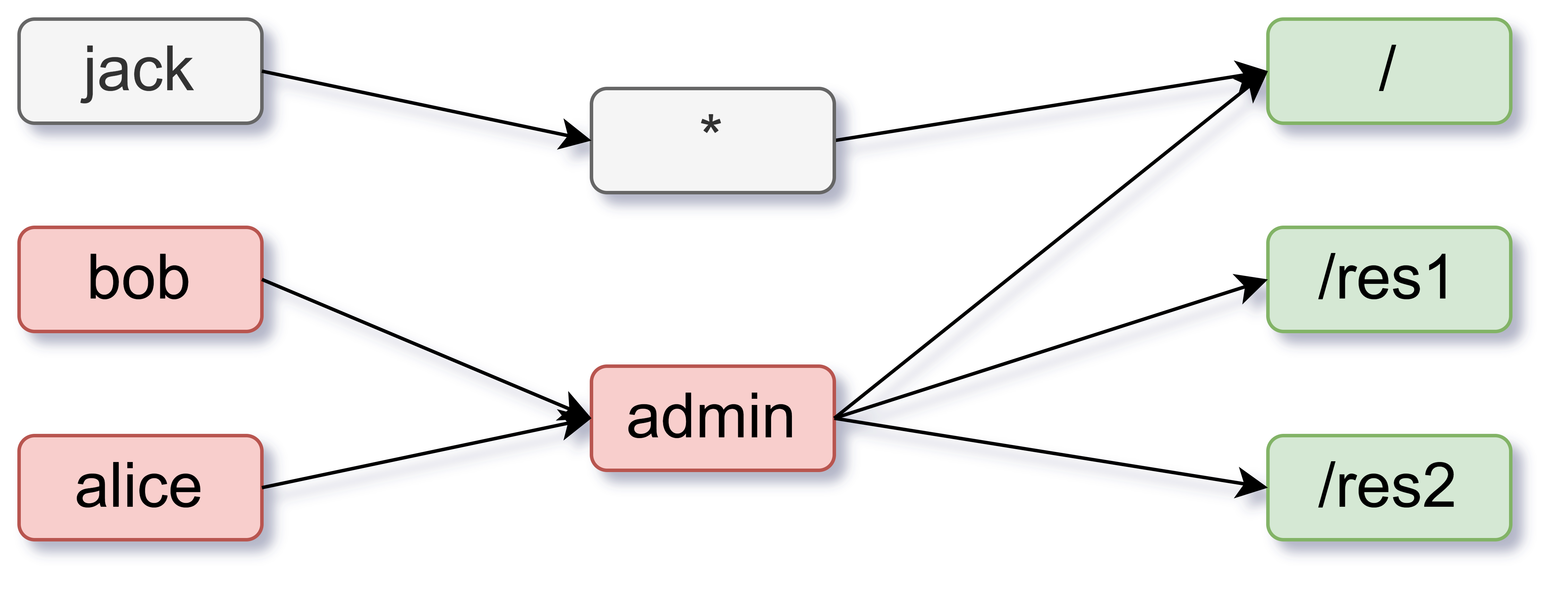
So: any user (e.g. jack) can access /; users with the admin role (e.g. alice, bob) can access everything; and non-admin users are limited to GET. Here is a model that does that:
[request_definition]
r = sub, obj, act

[policy_definition]
p = sub, obj, act

[role_definition]
g = _, _

[policy_effect]
e = some(where (p.eft == allow))

[matchers]
m = (g(r.sub, p.sub) || keyMatch(r.sub, p.sub)) && keyMatch(r.obj, p.obj) && keyMatch(r.act, p.act)
Створення політики
For the scenario above, the policy could be:
p, *, /, GET
p, admin, *, *
g, alice, admin
g, bob, admin
The matcher means:
(g(r.sub, p.sub) || keyMatch(r.sub, p.sub))— The request subject either has the policy subject as a role or matches it viakeyMatch. ForkeyMatchand other built-ins, see Lua Casbin BuiltInFunctions.keyMatch(r.obj, p.obj)— The request path matches the policy object.keyMatch(r.act, p.act)— The request method matches the policy action.
Enabling the plugin on a route
After creating the model and policy, enable the plugin on a route via the APISIX Admin API. Using file paths:
curl http://127.0.0.1:9080/apisix/admin/routes/1 -H 'X-API-KEY: edd1c9f034335f136f87ad84b625c8f1' -X PUT -d '
{
    "plugins": {
        "authz-casbin": {
            "model_path": "/path/to/model.conf",
            "policy_path": "/path/to/policy.csv",
            "username": "username"
        }
    },
    "upstream": {
        "nodes": {
            "127.0.0.1:1980": 1
        },
        "type": "roundrobin"
    },
    "uri": "/*"
}'
The username field is the header name that carries the subject (e.g. if the header is user: alice, set "username": "user").
To use inline model and policy text instead of files, use the model and policy fields:
curl http://127.0.0.1:9080/apisix/admin/routes/1 -H 'X-API-KEY: edd1c9f034335f136f87ad84b625c8f1' -X PUT -d '
{
    "plugins": {
        "authz-casbin": {
            "model": "[request_definition]
            r = sub, obj, act

            [policy_definition]
            p = sub, obj, act

            [role_definition]
            g = _, _

            [policy_effect]
            e = some(where (p.eft == allow))

            [matchers]
            m = (g(r.sub, p.sub) || keyMatch(r.sub, p.sub)) && keyMatch(r.obj, p.obj) && keyMatch(r.act, p.act)",

            "policy": "p, *, /, GET
            p, admin, *, *
            g, alice, admin
            g, bob, admin",

            "username": "username"
        }
    },
    "upstream": {
        "nodes": {
            "127.0.0.1:1980": 1
        },
        "type": "roundrobin"
    },
    "uri": "/*"
}'
Using a global model and policy
To use one model and policy for all routes, store them in the plugin’s metadata. Send a PUT request:
curl http://127.0.0.1:9080/apisix/admin/plugin_metadata/authz-casbin -H 'X-API-KEY: edd1c9f034335f136f87ad84b625c8f1' -i -X PUT -d '
{
"model": "[request_definition]
r = sub, obj, act

[policy_definition]
p = sub, obj, act

[role_definition]
g = _, _

[policy_effect]
e = some(where (p.eft == allow))

[matchers]
m = (g(r.sub, p.sub) || keyMatch(r.sub, p.sub)) && keyMatch(r.obj, p.obj) && keyMatch(r.act, p.act)",

"policy": "p, *, /, GET
p, admin, *, *
g, alice, admin
g, bob, admin"
}'
Then enable the plugin on a route (it will use the metadata). Example:
curl http://127.0.0.1:9080/apisix/admin/routes/1 -H 'X-API-KEY: edd1c9f034335f136f87ad84b625c8f1' -X PUT -d '
{
    "plugins": {
        "authz-casbin": {
            "username": "username"
        }
    },
    "upstream": {
        "nodes": {
            "127.0.0.1:1980": 1
        },
        "type": "roundrobin"
    },
    "uri": "/route1/*"
}'
The route then uses the shared model and policy from metadata. To change them, send another PUT to the plugin metadata; all routes using it will pick up the update.
Use cases
- Per-route authorization — Attach the plugin to any route with your model and policy. Good when different routes need different permissions or when policies are large (each route only loads what it needs).
- Global model/policy — Store one model and policy in plugin metadata and reference it from many routes. Updating policy in one place (e.g. etcd) updates all those routes.